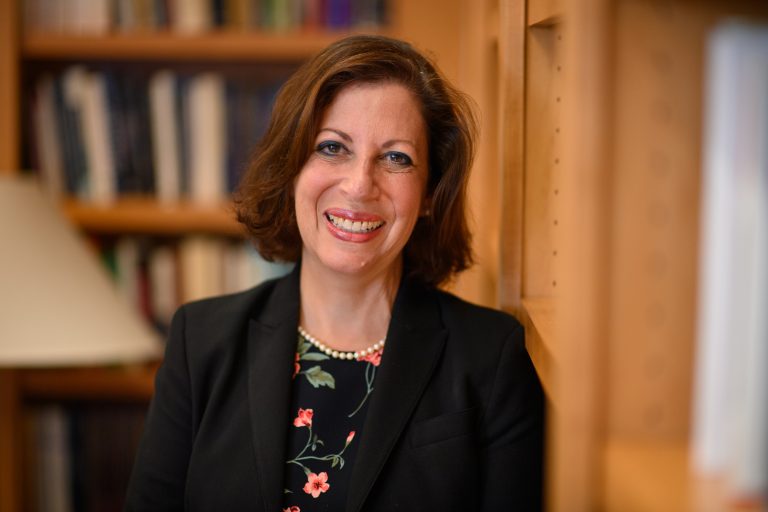


CERL’s Professor Claire Finkelstein spoke with media about the U.S. Supreme Court’s decision on Monday to grant former President Donald Trump partial immunity from criminal prosecution on interference charges.
“I believe that this decision is going to go down in the history of the United States Supreme Court as among its worst decisions ever — right there with the Korematsu case, the Lochner case, the Dred Scott case, and cases of that sort,” said Finkelstein. “This is a gut punch to U.S. democracy. To find that a U.S. president may now freely violate the criminal law, commit crimes possibly to remain in office, is a shocking decision, one that I believe is very inconsistent with the history of the Court’s other rulings.”
The Court chose to remand the case to lower court, placing critical choices in the hands of Tanya Chutkan, a judge on the U.S. District Court in Washington. Chutkan will decide on the timing of the trial, as well as whether some of the allegations against the former president will be tossed out.
“It will now fall to Tanya Chutkan to minister over the separation of personal capacity acts from two other categories that the Court has identified — which is core acts committed in the core constitutional capacity of the president’s constitutional duties, and official capacity acts,” said Finkelstein. “Justice Roberts distinguishes those two categories from one another and says that presidents are entitled to immunity in the first category, and are entitled to a presumption of immunity within their official capacity.”
Finkelstein and other legal experts predict that there will be some contention over what exactly constitutes official and unofficial presidential acts, and what exactly constitutes a president’s core constitutional duties.
“I would think that, in this case, Tanya Chutkan will be clear that the president was acting here in his personal capacity, because it was part of his election campaign,” said Finkelstein. “That is the archetype of the personal capacity act. So the speech that he gave on January 6, in which he encouraged everyone to march down to the Capitol, that was a personal capacity speech.”
“If Donald Trump is reelected, it would be a signal to him that he can commit crimes as long as he cloaks them in the language of official capacity. And that will be true for every president going forward.”
Claire Finkelstein is the Algernon Biddle Professor of Law and Professor of Philosophy and Faculty Director of the Center for Ethics and the Rule of Law. Read her bio here.
The views expressed here are the author’s own and do not necessarily represent those of any organization or university.